Square Cylinder - JoAnn Ugolini "Tutti Piccoli Santi"
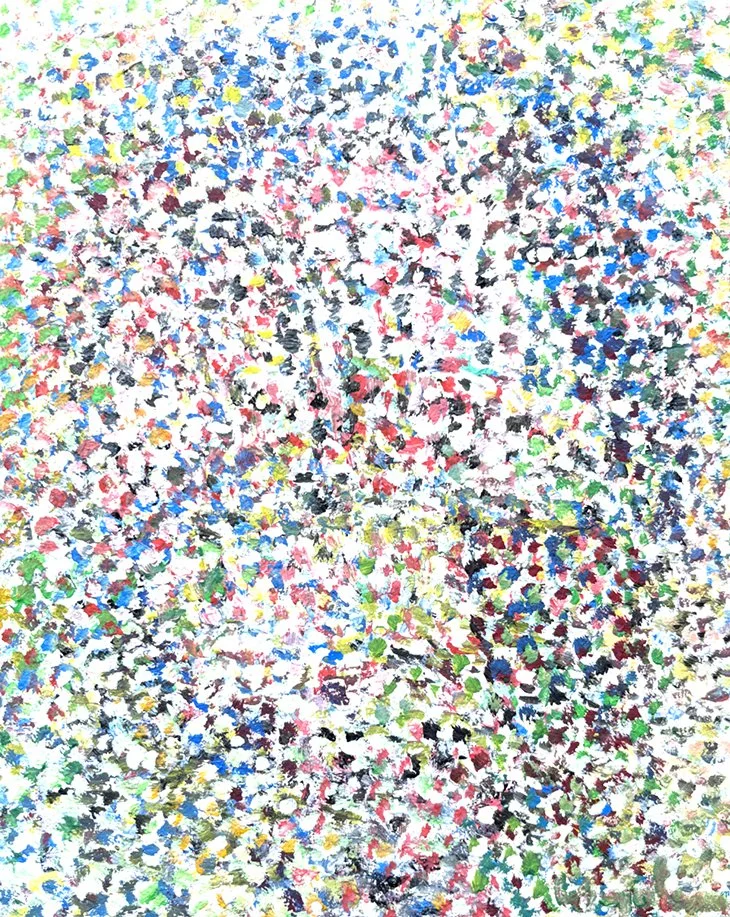
JoAnn Ugolini, “Freedom 1,” 2026, flashe on canvas, 44 x 35 x 1”.
All images courtesy of K. Imperial Fine Art, San Francisco.
Through August 8, 2026
Paintings can be a now-you-see-it-now-you-don’t experience, an elusive spectacle that keeps us off balance. That is certainly the case with JoAnn Ugolini’s 14 recent canvases in “Tutti Piccoli Santi” (All the Little Saints). Each manifests as a burst of swirling colors that overlap into mesh-like configurations that simultaneously coalesce and dissolve, half of which intimate ghostly faces when viewed from a distance. When we move toward them, the faces disappear into the work’s frothy surfaces, only to reappear as we step back. This phenomenon is called pareidolia, a common type of psychological projection that artists have exploited for centuries. A good example of this can be found is “Freedom 1” (2026), which slowly blooms in the mind’s eye as a cadaverous face. Indeed, Ugolini’s subtle faces can be sinister or even a bit scary, rather like what we imagine when we gaze into leaping flames or bilious clouds. This point needs to be stressed, because the overall demeanor of Ugolini’s paintings is ebullient and quite cheerful, deceptively so in more than a few instances.
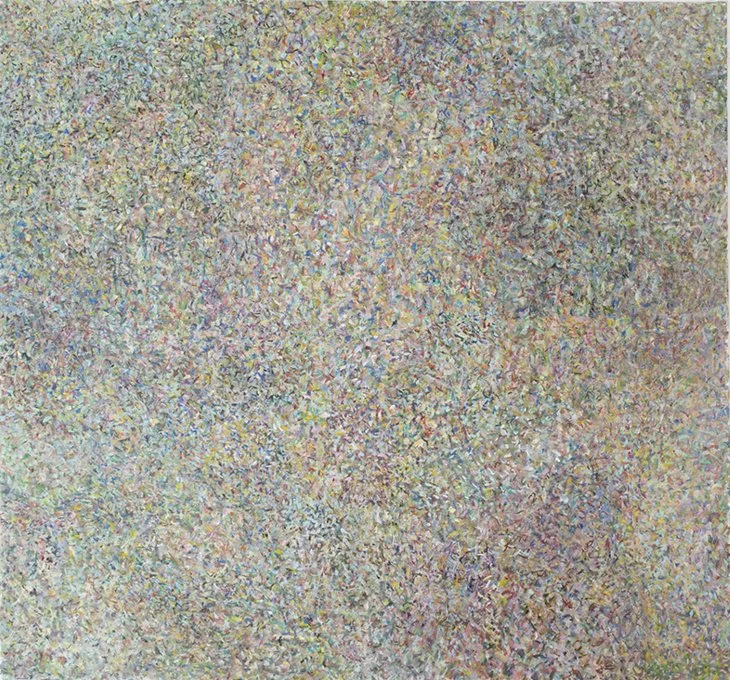
JoAnn Ugolini, “Awake on the Desert Floor,” 2025, flashe and acrylic on canvas, 54 x 58 x 1 1/2”.
Some of Ugolini’s paintings use a pointillist technique to good effect, reminding us not so much of Georges Seurat’s paintings as they do of the early Divisionist works of incipient Futurists Umberto Boccioni and Carlo Carra. In the large “Awake on the Desert Floor” (2025) we see a barrage of primary and secondary colors applied as discreet dots, prompting comparisons with dissolving pixels on a low-resolution video screen. Other paintings feature configurations formed from the kind of axe-cut brush strokes employed by Mark Tobey or Paul Cézanne. Good examples of this approach are the small works on paper titled “A World Away” and “All the Little Saints” (both 2025). The former may be seen as an aerial view of a landscape, or perhaps the turbulent undulations of a body of water rendered as a schematic web bathed in effervescent atmospherics. In all cases, the colors are vibrant, complex and never saccharin.
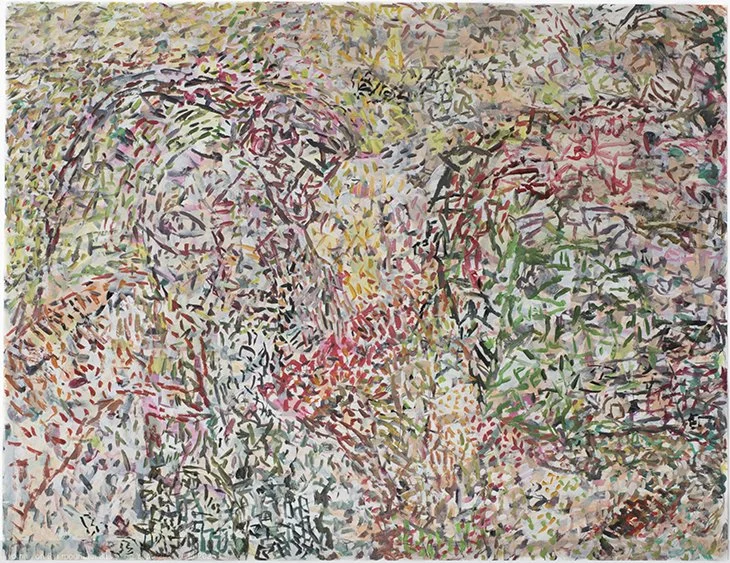
JoAnn Ugolini, “A World Away,” 2025, flashe on Yupo, 11 x 14”.
To achieve these chromatic effects, Ugolini uses flashe, a highly pigmented vinyl-based ink that handles very similarly to gouache. She also incorporates other inks and acrylics into her color mixtures, applying them to canvas, paper and a material called Yupo, a synthetic polypropylene paper that is non-absorbent. Yupo facilitates the flowing effects that Ugolini uses throughout to great success. The fluidity of her surfaces is both performative and descriptive, almost as if her brush is dancing the images into being. This connects Ugolini’s process to several calligraphic traditions, all united in the ways that the shapeliness of a given character can lend nuance to what it means.
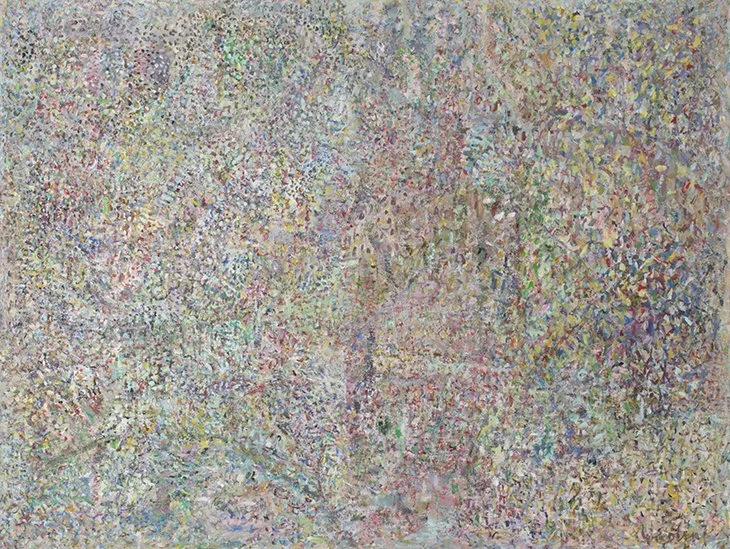
JoAnn Ugolini, “Sandrina,” 2025, flashe and acrylic on canvas, 48 x 64 x 1 1/2”.
This relates to the end of Michael Fried’s 1967 essay, “Art and Objecthood,” particularly his controversial distinction between Presence and Presentness. For Fried, Presentness was associated with the materialist theatricality of Literalist (i.e., Minimalist) sculpture, which he thought was a bad thing because it confused art with everyday objects. Presence, on the other hand, carried connotations of transcendental grace, a quality he found in the Color-field painting of Kenneth Noland and Jules Olitski. This is relevant to Ugolini’s work in that their surfaces initially address colorful material facts that can be enjoyed for their own sake. A second glance, however, changes these surfaces into something counter-factual and fantastic. Thus, we see that sometimes you can have it both ways if you look hard enough. But then, when you look that hard, you also should consider whether you are seeing something or only projecting what you either wish or fear to see.